

REINVENTING FINANCE WITH INTELLIGENCE,
INTEGRITY & IMPACT
WHO WE ARE
2026 © Fintecgrity. All rights reserved. developed by safraznazar.com
REINVENTING FINANCE WITH INTELLIGENCE,
INTEGRITY & IMPACT
WHO WE ARE
2026 © Fintecgrity. All rights reserved. developed by safraznazar.com

Explore our latest articles, practical guides, and sector reports on finance transformation, operations, and BPO success stories.
Read More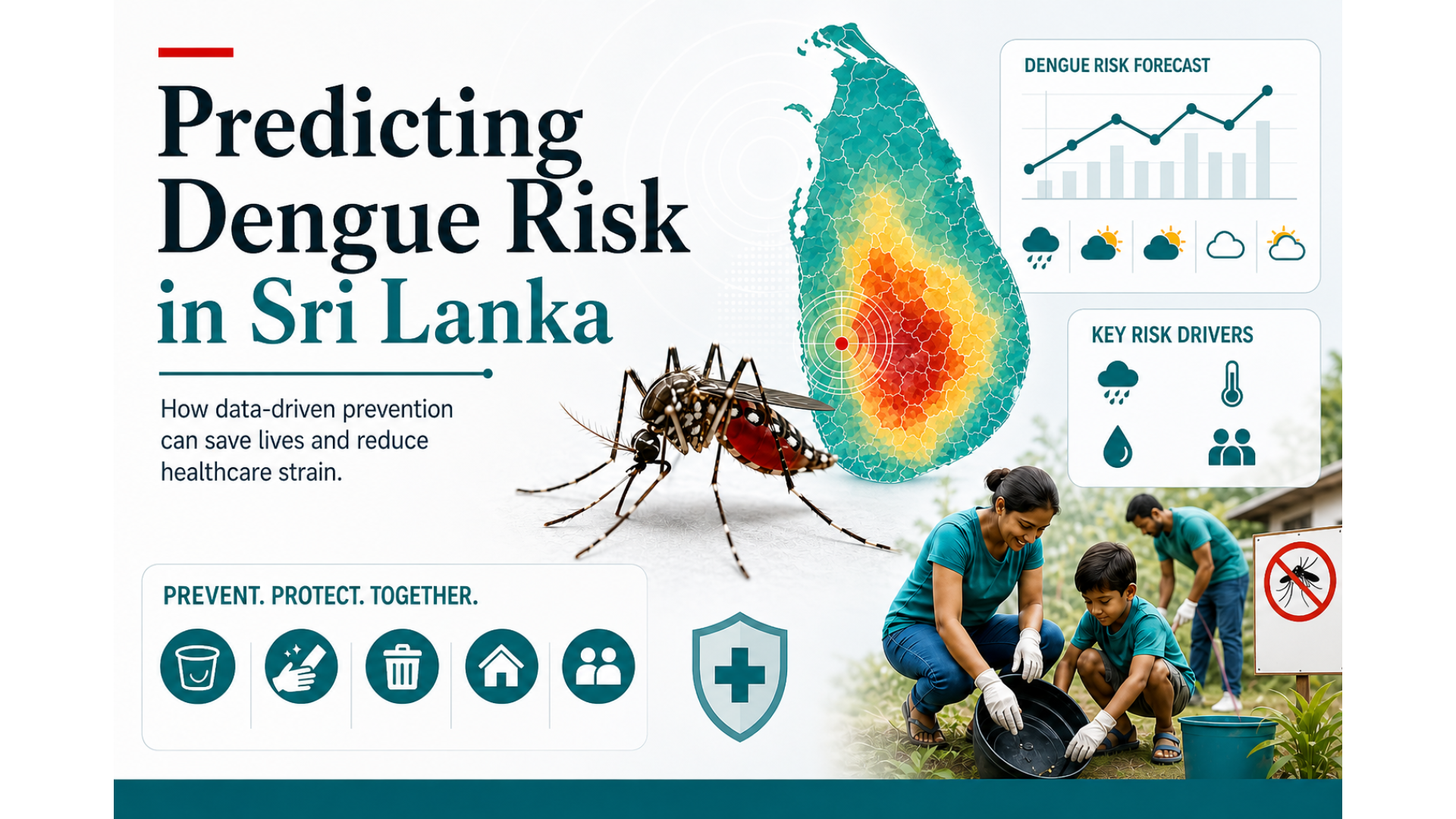
Dengue prevention in Sri Lanka needs to move beyond reactive response. New research shows that severe dengue patterns can be predicted using climate, geography, age, and gender-based risk factors helping local authorities and hospitals act earlier, target interventions better, and reduce pressure on the public health system. A smarter, data-driven approach could save lives, reduce costs, and strengthen national dengue preparedness.
The economic and healthcare strain of dengue outbreaks continues to place a crushing burden on Sri Lanka. Beyond the tragic cost to human life and the severe physical toll on patients, the disease drains billions of Rs. from government coffers annually. Treating a single severe pediatric case in the public health sector bears the brunt of these costs, providing free medical care to thousands of patients while funding year-round eradication efforts.
However, a groundbreaking multilevel analysis is poised to shift the national strategy from a reactive financial drain to a highly targeted, predictive prevention model from the University of Colombo, utilizing the clinical records of over five thousand dengue patients across fifteen districts. By deeply analysing this vast dataset, the authors uncovered critical new information: the most severe infection types—Dengue Hemorrhagic Fever Grade 1 (DHF1) and Grade 2 (DHF2)—do not share identical environmental or demographic triggers with standard Dengue Fever. This statistical revelation provides the exact blueprint needed for local governance and health sectors to time their interventions with precision, potentially saving lives and safeguarding the national health budget.
Understanding the new findings: DHF1 versus DHF2
Historically, public awareness campaigns have treated dengue as a single, uniform threat. The data reveals a stark gender disparity, showing that females are significantly more prone to suffering from the severe DHF2 strain than standard Dengue Fever when compared to males. Furthermore, patients under the age of twenty face a considerably higher risk of contracting both DHF1 and DHF2 compared to older demographics. Understanding exactly who is most at risk for the severest strains allows health officials to tailor their clinical vigilance.
This demographic insight is crucial because the research notes that patients suffering from DHF2 experience notably longer hospital stays than those with standard Dengue Fever. These extended stays place a specific, predictable strain on medical infrastructure, consuming ward beds, intensive care resources, and medical staff time, which heavily inflates the direct medical costs borne by the government.
The precise climatic lag effect
The research proves that the different virus serotypes respond uniquely to specific temperature, rainfall, and humidity variations over time. This means that the weather today dictates the specific strain of dengue that will circulate thirty to sixty days from now. For instance, the data shows that moderate rainfall in the previous month actually favours the emergence of DHF1 over standard Dengue Fever, while simultaneously reducing the presence of DHF2.
Conversely, the existence of moderate humidity two months prior practically doubles the risk of DHF2 while reducing the chance of DHF1. High temperatures two months prior displays a similar split, driving down DHF1 cases while pushing DHF2 cases up. Local councils no longer need to wait for a monsoon to pass before acting; they can proactively prepare for the exact severity of an impending outbreak based on these calculated lags.
Local geography and targeted local government action
For local governance, this signals an urgent need to rethink municipal responsibilities. Rather than applying a single eradication strategy across the board, the research demands a highly localized approach that differentiates between urban municipalities and rural local government bodies. A centralized fogging mandate is no longer scientifically or economically viable when the data proves that different areas breed entirely different severities of the disease.
This localized approach must be intricately tied to the specific geographic realities of each council area. These localized environmental features interact intimately with the specific humidity and rainfall lags identified in the study. Provincial councils must map their clearing operations based on proximity to these environmental features, recognizing how lakes and localized bodies of water can drastically amplify the delayed threat of severe hemorrhagic strains.
Mitigating the crisis and saving resources
By tracking the specific weather patterns from one and two months prior, hospitals in high-risk zones can accurately forecast the influx of severe, long-stay cases. Instead of scrambling when an outbreak peaks, healthcare networks can proactively allocate ward beds, stockpile blood bank reserves, and adjust nursing schedules weeks in advance.
For the government, this precision-timed intervention model is the key to mitigating the immense financial burden of the disease. By utilizing the predictive insights provided by Dr. Wickramasuriya and Prof. Sooriyarachchi, Sri Lanka can transition from blindly fighting a recurring epidemic to deploying state resources exactly when and where they are needed most. This targeted approach promises to reduce the overwhelming costs on the public health sector, minimize lost economic productivity, and most importantly, protect the most vulnerable populations from the severest impacts of the dengue virus.
Research by:
Prof. Roshini Sooriyarachchi | Senior Advisor – Predictive Systems & Statistics
Images by:
Nishel Fernando | Senior Business Journalist
Was this helpful?
Related Articles
Stay updated with the latest insights, industry trends, and expert analysis on finance transformation and operations.
View All ArticlesShare with your friends